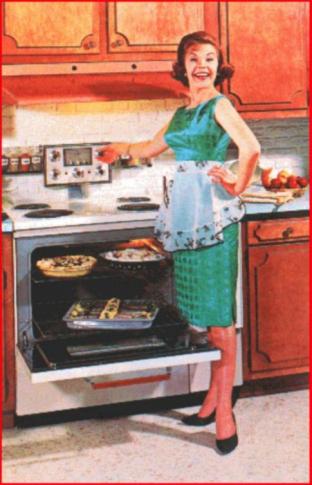
Showing posts with label 1950s. Show all posts

Sunday, November 20, 2011

Need a Dessert Recipe? Try Cherry Crap!

This story submission absolutely cracked me up! And hopefully will start a trend of people sending us recipes along with their stories.

This is from Trudy, the reporter at KAWC radio who recorded our interview. We'll have another great story from Trudy later this week, just in time for Thanksgiving, so stay tuned! :)

Cherry Crap

By Trudy Schuett


Through all the 1950s and most of the 1960s, my mother went to her Pinochle Club twice a month. Each lady took a turn hosting, and the dessert during a break in card playing was an important element of the evening. Everybody would exclaim how lovely that night's dessert was, and later on in the car, my mother and my aunt would say what they really thought. (One of the reasons they called it "Cat Club," no doubt.)

One lady frequently served a pumpkin pie with gravy, of all things; something I've never figured out or ever heard of anybody else doing.

A lot of the recipes in that era were based on convenience foods and Jello, and it wasn't too often Ma came home with a recipe. She was great at pies and cakes made from scratch, but every once in a while there would be one of the "Cat Club" desserts showing up at our house.

The following recipe for Cherry Crap is one of those, and nobody remembered how it got its name. I can only imagine the scene the first time Ma presented this, circa 1955:

Ma: (setting a glass cake pan on the dining room table) I got this recipe from Leona at Cat Club.

Dad: (viewing the dish with suspicion) What is it?

Ma: It's a Quick Cherry Pie!

Dad: Looks more like Cherry Crap to me.

Anyway, no matter what Dad thought of the looks, we all liked it, and I still make it today. Here's the recipe:

11 graham crackers, crushed, or pre-crushed graham cracker crumbs for two crusts (found in the baking aisle of the store)
1/3 cup sugar
1 stick (1/2 cup) butter or margarine
1 can cherry pie filling
Cool-Whip or spray whipped creme

Melt butter in microwave in microwave-safe mixing bowl. Add crumbs and sugar; mix well. 
Layer half the crumb mixture in the bottom of a 9x9 square cake pan, spread pie filling over crumbs. Top with the rest of the crumbs. Refrigerate for at least three hours or overnight.

Serve with your choice of topping.

Note: Back when we lived in Detroit I tried making this once with fresh cherries from our tree, and real whipped creme but it just wasn't the same. You really want that chemical-y goodness for this one!

Thanks, Trudy!

Monday, September 5, 2011

Guest Post: Gordon W. Fredrickson


To our readers:


I recently came across a blog written by a gentleman named Gordon W. Fredrickson: Telling the Story of Rural America. One of Gordon's main themes is "A story not told is lost forever." I absolutely love this quote as I think it sums up exactly what we are trying to do with Senior Share Project. Gordon shares the same love we do for preserving memories.

Gordon has generously allowed us to re-publish this post that he wrote about growing up in rural Minnesota.


Thank You, Gordon, for sharing this with our readers! 

Countryside 1950
by Gordon W. Fredrickson

The shows I've been doing for kids and adults for 10 years focus on activities and events with a small family farm in 1950. Since people in my audiences range in ages  from 1 to 100, the images they have of what the countryside was like in 1950 vary greatly.

Older folks have specific memories, but since elementary school kids and teens do not, I use some pictures at the beginning of my show to try to characterize the countryside during the 1940's and 1950's.

I cover just 6 categories:

1. HORSES


In 1950, most small farms in this area had at least one team of horses for several reasons:

 a) For one reason or another, they may not have owned a dependable tractor, and even if they were able to afford a good tractor, much of their equipment was set up for horses. To buy all new equipment or convert what you had to be pulled by a tractor took time and money.

b) The roads were so poor that they would easily drift shut in the winter and remain closed for days or weeks. To get to town farmers used a team of horses to pull a sleigh over the snow-covered high ground, not the roads. Also, the milk truck couldn't get to the farms to pick up the milk and the farmer had to use the horses and sleigh to get the milk to a main highway where the hauler could pick it up.
In the spring the roads were even worse and remained too muddy to use for weeks.

c) For some farmers, the horses had become like old friends and they were reluctant to part with them. The picture above is from 1954 when my parents decided to sell Bill and Daisy.  Dad and I posed for a picture before we loaded them on the truck. There were no pictures taken of events like my first day of school or any number of other occasions, but parting with Bill and Daisy warranted a photo.

2.  FARM HOUSES


a) Although some farm houses were quite nice, especially on larger farms where the land had been passed on to the next generation, farm houses on really small farms that had been left to deteriorate through the hard times of the 1920's and 1930's were not in good shape, and these were the only farms new farmers could afford to buy. 
The above picture is the house on my parents' farm when they moved into it in 1940. They fixed it up some in the 1940's but were not able to remodel until 1952. Indoor plumbing came in 1958, though the barn had running water in the mid-1940's.

b) Another thing about housing in the country is that there were no housing developments. The only buildings in the country were buildings connected with a farm. No one would think of living in the country unless they farmed.

3. FARM BUILDINGS


a) Small farms did not usually have a lot of sheds for machinery or tools.
Granaries, hay barns and chicken coops often doubled as tool sheds. Many farms had no garage or shed for a tractor or car.

The above picture is my parents' farm about 1957. Note the house has been remodeled. When my folks moved onto the place in 1940, there was no barn, no silo, no milk house, no chicken coop, no granary and no well.

b) In 1950 there were no pole sheds, or at least very, very few. Note the milk truck box on the cow yard ground on the right side of the photo. I think Dad bought it for about $25 to house young stock.  The pole building boom started a few years later.

c) Sheds made from railroad cars were fairly popular because the well built cars were heavy and great for storing grain.  The picture of the one below was taken recently, but you can imagine when the roof was first erected over the two cars, the structure looked pretty nice.

    
4. COUNTRY STORES


Country stores like this one in St. Patrick dotted the countryside near lakes or crossroads. Note the feed mill nearby where farmers could bring their corn and oats to be ground and mixed.

5. PEDDLERS 


Peddlers were often seen in the countryside.
The peddler's name in the picture above is Jaffe and he traveled the area in the 1930's, 1940's and 1950's.

Note the wagon had steel front wheels and rear rubber tires. I don't know much about what he had in the wagon, but I know he carried socks and other clothes and some kitchen utensils, but no electrical utensils because most weren't invented yet or just not used in a 1950 farm kitchen.  He also sharpened tools and scissors, etc. and would trade his stuff for eggs or chickens if the farmer had no cash.

When I show this picture to audiences at senior centers, many remember Jaffe.

6. CHORES


Farmers did chores by hand. Few farmers had anything automatic. Most dairy farmers in this area milked by hand, too.

I'll just name a few more of the many other differences between 1950 and the present:
  • There were no shopping centers or chain stores, but small towns had general stores that carried groceries and clothing. 
  • Small towns had movie theaters, shoe stores, car dealers, tractor dealers, and ice cream shops.
  • There were no fast food "restaurants", but small towns had soda fountains, cafes, family-owned restaurants, and taverns that sold hamburgers.
Anything else you can think of?

To read more about Gordon, invite him to speak at your event or to order any of his books please visit him here:

Or to read more about rural living, visit his blog:

Thanks for stopping by!
Heidi and Eileen

Sunday, August 28, 2011

World Series on the Sly

Click for outside article on Herb Score
by Marty Roselius

In America, baseball, football and basketball held the attention of sports fans during the 1950s. These three major sports had highly recognized professional leagues and were the primary activities high schools of the area competed in almost to the exclusion of others. 

I followed the professional teams and their star players through my collection of sports cards. In Key West, being a few states and more than a thousand miles removed from the nearest major league city, there were no radio broadcasts of games, although a few would be telecast nationwide on the weekend by one of the three networks. Without a prized television standing in the corner of our family’s living room, my exposure to professional sports was minimal. Nevertheless, I always found a way to stay on top of who was leading the division, how the hated Yankees were doing (they always won), and how my favorite players were faring. 

In 1948 there were only 190,000 TV sets in all of America, but with sports becoming a major portion of television programming during this period, it quickly grew to 10.5 million sets two years later. Radio broadcasts were quite popular as most families had radios, whereas many could not afford a television in the days before the common use of credit cards.

In the major leagues there were only sixteen teams, all concentrated in cities in the northeast and Midwest. There was no team west of St. Louis until the Giants moved to San Francisco in 1958, or south of Washington, D.C. until the Braves moved to Atlanta in 1966. But there were still two leagues, The American League and The National League. And the World Series pitted the two best teams of the year, the two champions, against each other for the World Championship.

Start times were a little different too. Ballgames were played during the middle of the day, regardless whether the game was the first of the season or the seventh game of the World Series. Television and radio networks broadcast the games live, during daylight hours, as they were traditionally played. 

So for us school kids, this presented a major league dilemma. The World Series is on the radio. And heck, we’re sitting behind a school desk! That left us with only one alternative. Sneak our transistor radios into class, beneath the watchful eyes of our most unsympathetic teachers. However, some genius inventor acknowledged our dour predicament and developed an amazing invention that made this possible—an earpiece that allowed us to listen to the radio without any audible sound that could be detected by a teacher. With great skill we carefully concealed the small earpiece, feeding the thin wire down our shirt collar to the transistor radio hidden in our pockets. Resting our elbow on the desk, we leaned our head against the open palm of our hand to cover it. 

Willie Mays famous over the shoulder
1954 World Series catch
This deception created a difficult challenge: following the action of the game while not making sudden and compromising sounds, gestures or facial expressions during the excitement of play. Our teachers were aware of the conflict their classroom priorities had with the broadcast of the World Series and were ever watchful for the telltale signs of a distracted student. These World Series games were made even more exciting since we had to follow them discreetly, with the threat of a paddling and the loss of our prized electronics in the midst of the most exciting sports event of the year, if we got caught. But, holy sneakers, we just couldn’t miss the game, at any risk.

I didn’t, get caught that is, and enjoyed the excitement of many a Mickey Mantle home run or a famous Willie Mays’ over-the-shoulder catch from center field while Mrs. Wagner or Mrs. Haskins dutifully carried on their teaching responsibilities with a history lesson from the front of the class. I don’t remember those history lessons, but I do remember those World Series’, which in fact, are history lessons in themselves, aren’t they?


Related Posts Plugin for WordPress, Blogger...